
How to Stop Linen Fraying: Seam Finishes That Work
To stop linen fraying, finish every cut edge with stitches or enclose it inside the seam. For most projects, a zigzag or overcast stitch is the simplest option, while an overlocker gives a fast, durable finish. French seams suit lightweight linen; flat-felled seams work well where strength and a tidy finish matter; and bound seams are useful when the inside will remain visible.
The best choice depends on the linen's weight and weave, the shape of the seam and how often the finished item will be washed. Test the finish on an offcut first: the method should control loose yarns without puckering, stretching or adding too much bulk.
Why does linen fray?
Linen is a woven fabric, so cutting it exposes warp and weft yarns at the raw edge. Handling and laundering can loosen those yarns, especially in a relatively open weave. A closely woven, medium-weight linen may shed only a few threads; a loosely woven or heavily washed linen can unravel much more quickly.
Fraying at the cut edge is normal and does not mean the fabric is poor quality. It does mean that you should allow an adequate seam allowance, handle cut pieces carefully and choose a finish before the edge becomes too narrow to secure.
Prepare the linen before you cut
If the finished project will be washable, prepare the fabric according to its care instructions before cutting. This deals with expected shrinkage in advance and shows how the weave behaves after laundering. Our guide to washing linen fabric before sewing explains when prewashing is appropriate.
- Press the fabric and align it with the grain before placing the pattern.
- Use sharp shears or a rotary cutter so the edge is clean rather than pulled.
- Transfer notches with small clips that stay well inside the seam allowance.
- Avoid repeatedly lifting or moving loosely woven cut pieces.
- If an edge begins to shed immediately, stay-stitch inside the seam allowance before further handling.
Do not trim a fraying seam allowance too closely. Linen needs enough fabric between the stitching line and the raw edge to resist the yarns pulling away under wear.
Which seam finish should you use?
- Lightweight or semi-sheer linen: French seams, a narrow three-step zigzag or a fine overcast finish.
- Medium-weight clothing linen: zigzag, overlock, clean-finished, French or flat-felled seams, depending on the design.
- Heavy linen: overlocked or separately bound allowances; avoid an enclosed finish if several folded layers become bulky.
- Unlined jackets and visible interiors: Hong Kong or bias-bound seams for a deliberate, polished result.
- Frequently washed home textiles: a robust overlocked, French or flat-felled finish that completely controls the raw edge.
Make a seam sample using the same number of layers as the real project. Press it and, if the item will be laundered, wash the sample before deciding.
Zigzag or overcast stitch: the accessible everyday finish
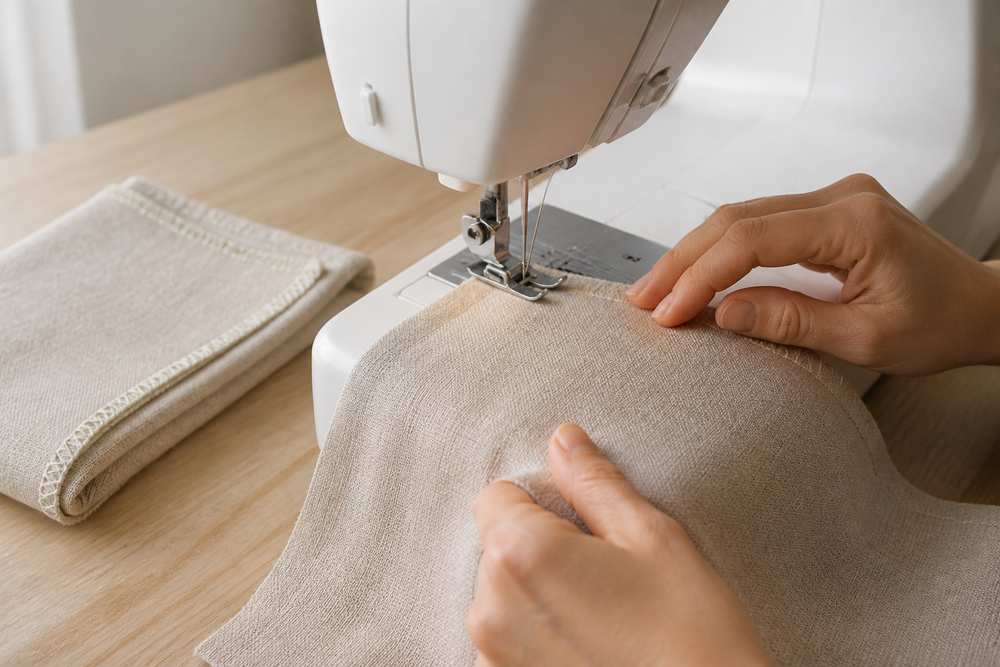
A basic zigzag is available on most domestic sewing machines and works well for many medium-weight linens. Sew close enough to the edge that the outer swing of the needle helps secure the yarns, but avoid a stitch so narrow or tight that it tunnels the fabric.
A three-step zigzag spreads the thread over a wider area and can lie flatter on a softer or lighter linen. If your machine has an overcast stitch, use the matching overcasting foot: its guide helps the stitch wrap the edge without rolling it inward. Finish each allowance separately when the seam will be pressed open, or finish both together when the pattern instructs you to press them to one side.
Overlocked seams: fast and durable
An overlocker, also called a serger, trims and wraps the raw edge in thread in one pass. It is efficient for clothing, cushion covers and other projects with several straight or gently curved seams. Match the thread coverage and differential feed to the fabric so the edge stays flat rather than rippling.
Do not let the machine remove too much seam allowance. For a fabric that frays readily, stitch the construction seam first and overlock beside it, or overlock the individual pieces before assembly when the pattern and fitting process allow.
French seams: enclosed edges for lightweight linen
A French seam encloses the raw allowances inside a second seam. Sew the first seam with wrong sides together, trim the allowances evenly, press, turn the fabric right sides together and sew again so no cut edge remains visible.
This finish is elegant for lightweight shirts, dresses, pillowcases and unlined pieces, but it needs enough total allowance for both passes of stitching. It can be awkward on tight curves and bulky in heavy linen. Check the pattern allowance before beginning rather than adding a French seam to a construction drafted for a different finish.
Flat-felled seams: strong, flat and tidy
A flat-felled seam encloses one trimmed allowance beneath the other and secures the folded edge with a second row of stitching. The result is strong, washable and neat on both sides, making it useful for shirts, trousers, aprons, bedding and other projects that benefit from reinforcement.
Because the finish is topstitched, it becomes a visible design detail. It is less convenient where seams must be altered later, and several folds can feel heavy in thick linen. Practise the folding sequence on a sample and press at each stage.
Clean-finished seams: turn and stitch
For a clean finish, turn a narrow amount of each raw allowance to the wrong side and stitch close to the fold. It needs no special machine and leaves a controlled, simple interior. This is most successful on straight seams in light- to medium-weight linen with enough allowance to form an even fold.
The extra fold can become bulky at intersections, and a very loose weave may continue to pull beneath a narrow turn. Grade bulky junctions carefully and choose an enclosed or bound finish when the fabric needs more protection.
Bias-bound and Hong Kong seams: a polished visible interior
Binding wraps a strip of lightweight bias fabric around the raw allowance. In a conventional bound finish, both sides of the binding are secured; in a Hong Kong finish, the inner edge of the binding is usually left flat after the outer edge is stitched in place.
These finishes are attractive inside unlined jackets, bags and decorative home projects. Choose a fine binding compatible with the care method of the linen. A heavy commercial bias tape can add unnecessary stiffness, so test the combination before binding an entire garment.
Are pinking shears enough for linen?
Pinking reduces the length of the exposed yarns, but it does not fully enclose or stitch the edge. On a firm, closely woven linen used in a lightly handled project, it may be an acceptable temporary or supplementary finish. For loose linen, clothing or anything washed regularly, choose a stitched finish instead.
Fabric glue, sealant and iron-on products belong to a different group of techniques. They may suit craft pieces that will not be stressed or frequently laundered, but they can stiffen or mark linen. See our separate guide to sealing fabric edges without sewing for those applications.
How to manage curves, corners and loose weaves
Curved allowances often need clipping or notching so they can turn smoothly, but every cut creates another place where yarns can loosen. Stitch or overcast before clipping where the construction permits, and never clip through the main seam. On a tight curve, a narrow bound finish or lining may behave better than a bulky French seam.
With very loose linen, add a row of stay-stitching inside the seam allowance soon after cutting. Use a generous allowance and avoid pulling the pieces through the machine. If yarns slide away from the construction stitches rather than simply fraying at the edge, the problem may be seam slippage; a wider allowance, a reinforced seam or a different fabric may be needed.
Common mistakes that lead to fraying seams
- Trimming the allowance too close before the edge is secured.
- Using a dense zigzag that puckers or perforates lightweight linen.
- Choosing French or flat-felled seams where folded layers create too much bulk.
- Clipping curves beyond the construction stitching.
- Leaving raw allowances unfinished in an item that will be washed often.
- Skipping the test sample and discovering too late that the finish distorts the weave.
If the edge puckers as you sew, check the needle, thread tension, presser-foot pressure and stitch density on a scrap. Our guide to fabric puckering at the sewing machine covers the main causes.
Can an already-fraying seam be rescued?
If the damage is still within the original allowance, remove loose threads without pulling them, press the area flat and secure the edge with an overcast or overlocked stitch. Reinforce the construction seam if the remaining allowance is narrow. A lightweight bias binding can contain a weak edge when there is enough fabric to support it.
When fraying has reached the seam line, unpick only as much as necessary and reconstruct the section with a wider or reinforced seam. For holes, tears and worn areas beyond the seam allowance, use the methods in our guide to repairing linen fabric.
A simple decision checklist
- Will the item be washed frequently?
- Is the linen light, medium or heavy?
- Is the weave close or loose?
- Should the finished seam press open or to one side?
- Will the inside remain visible?
- Does the seam curve sharply or cross bulky junctions?
- Does your test sample stay flat after pressing and washing?
For most beginner projects, start with a well-tested zigzag, overcast or overlocked finish. Move to French, flat-felled or bound seams when the fabric weight and design benefit from a fully enclosed edge. You can find more preparation and construction advice in our top tips for sewing with linen, then compare suitable cloth in the linen clothing fabric collection or order fabric samples before committing to a project.
Frequently asked questions
What is the easiest way to stop linen fraying?
For most medium-weight linen, a zigzag or overcast stitch is the easiest option on a domestic sewing machine. Test the width and length on an offcut so the edge is covered without puckering.
Should linen edges be finished before or after sewing the seam?
Either can work. Finish pieces first when they fray quickly or will be pressed open; finish both allowances together after construction when the pattern calls for them to lie to one side. Enclosed seams are made as part of the construction sequence.
Is a French seam suitable for every linen weight?
No. French seams are best for light and some medium linens. They can become bulky in heavy fabric and are awkward on tight curves or seams that may need alteration.
Will pinking shears stop linen from fraying in the wash?
Not reliably. Pinking can slow fraying on a closely woven fabric, but washable clothing and home textiles usually need a stitched, overlocked, enclosed or bound seam finish.