

How Often Do We Change our Bed Sheets?
Updated August 10, 2026: this article has been refreshed with clearer guidance on how often to change sheets and what can alter your routine.
How often should you change your bed sheets?
For many households, changing sheets about once a week is a practical starting point. A weekly routine helps remove the body oils, perspiration, skin cells and everyday dust that build up during sleep. It is not a rigid rule: some beds stay fresh longer, while others need clean sheets sooner.
Your schedule should reflect how the bed is used, the season and the people sleeping in it. If you shower before bed, wear clean nightclothes and sleep alone, you may be comfortable stretching the interval slightly. Hot weather, heavy perspiration, pets on the bed or eating in bed usually call for more frequent changes.

When to change sheets more frequently
- After illness: replace bedding once the person is recovering and sooner if it becomes damp or soiled.
- During hot weather: perspiration can make pillowcases and fitted sheets feel stale more quickly.
- When pets share the bed: hair, outdoor dirt and dander can accumulate on the surface.
- For allergy-sensitive sleepers: follow advice appropriate to the individual and keep pillowcases and bedding clean.
- For babies and young children: change bedding whenever it is wet or soiled and keep a spare set ready.
Pillowcases often need attention before the rest of the bed because they collect facial oils and hair products. Keeping spare pillowcases makes it easy to replace them between full bedding changes.
A simple three-set rotation
Three sets of bed linen make a regular washing schedule easier: one on the bed, one clean and stored, and one being washed or dried. This prevents rushed laundering and gives each set time to dry completely before it is put away.
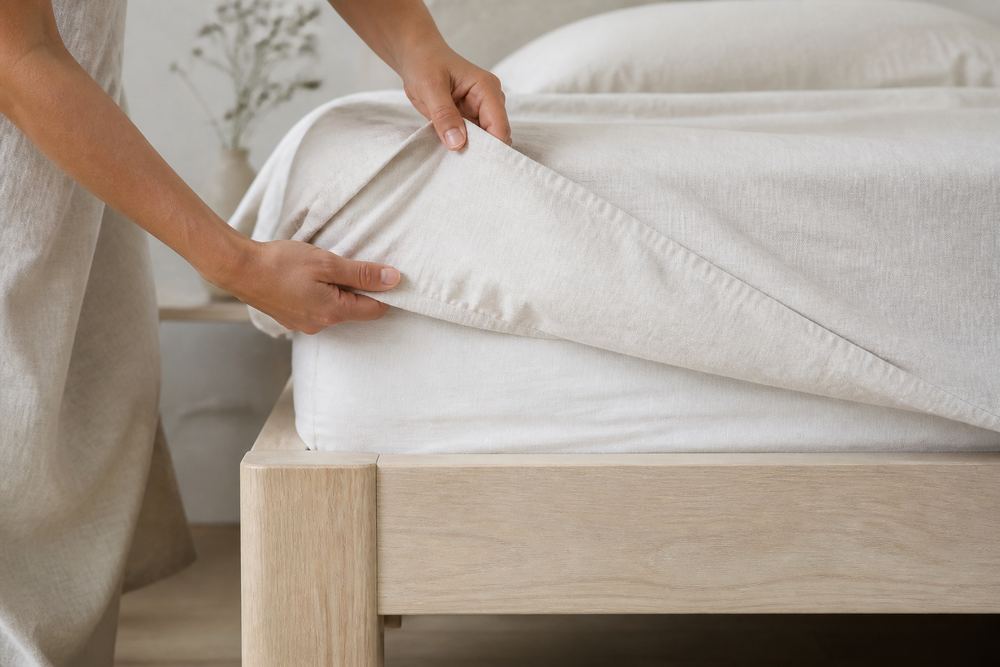
Choose sets that can be washed together and label unusual sizes if several beds use similar-looking linen. Store fitted and flat sheets with their matching pillowcases so that the complete set is easy to find. If you are deciding between the two styles, see our guide to flat and fitted sheets.
How to wash and store linen bedding
Always check the care label. Wash similar colours together with a mild detergent and leave enough space in the drum for the bedding to move and rinse. Avoid using more detergent than necessary, and do not store sheets until they are completely dry.
Air-dry when practical, or use a low tumble-dry setting if the label allows it. Removing linen while slightly damp can reduce deep creasing. Fold it once dry and store it in a cool, ventilated cupboard away from direct sunlight and moisture.

Use comfort and cleanliness as your guide
A calendar is helpful, but the condition of the bedding matters most. Change sheets whenever they smell stale, feel damp, show visible marks or no longer feel comfortable. A realistic routine that you can maintain is more useful than an inflexible rule.