

How Much Fabric Do I Need for Roman Blinds?
Quick answer: for a flat Roman blind made from plain fabric, calculate the finished blind width plus side allowances, then the finished drop plus the top fixing and bottom hem allowances. If that cut width fits inside one usable fabric width, you normally need one cut length. If it does not, multiply the cut length by the number of fabric widths required. Patterned fabric must also be rounded up to complete vertical repeats.
A useful planning allowance is often about 20–25 cm (8–10 inches) added to the finished drop, but construction methods differ. Follow the allowances specified by your blind kit, pattern or workroom before cutting. The formula below is a reliable way to estimate how much linen fabric for home décor to order.
Roman blind fabric calculator formula
Start with the finished size of the blind—not only the glass measurement.
- Face-fabric cut width = finished blind width + both side allowances.
- Basic cut drop = finished blind drop + top allowance + bottom hem allowance.
- Number of fabric widths = cut width ÷ usable fabric width, rounded up.
- Total plain fabric = number of widths × basic cut drop.
- Total patterned fabric = number of widths × pattern-adjusted cut drop.
A Roman blind hangs flat when lowered, so it does not need a curtain-style fullness allowance. That is the important difference between calculating a blind and calculating gathered curtains.
Measure the finished blind correctly
Inside the window recess
Measure the recess width at the top, middle and bottom, and measure the drop at the left, centre and right. Window openings are rarely perfectly square. Use the narrowest width as your starting point and follow the blind system’s instructions for the small clearance deduction needed to stop the blind rubbing or jamming.
Outside the window recess
Decide how far the blind should overlap the opening at each side and above and below the window. Measure the exact finished width and drop of the planned blind. Check that the raised stack will clear handles and that the fixing surface can support the headrail or batten.
Record every measurement in one unit. Mixing centimetres and inches is an easy way to make an expensive cutting error.
Choose the correct fabric width
Check the usable width of the exact fabric after excluding any selvedge that cannot remain in the finished blind. Many furnishing fabrics are around 137–150 cm (54–59 inches) wide, but the specification on the product page is the figure that matters.
If the required cut width fits within one usable width, the blind can be made without vertical joins. If it is wider, do not automatically place one full-width panel at one side. A balanced layout usually uses a full width in the centre with equal narrower pieces joined to both sides, keeping seams symmetrical when the blind is lowered.
Allow for hems, the headrail and bottom bar
There is no single universal allowance because Roman blinds can be made with different battens, headrails, tapes and bottom-bar pockets. As a planning estimate, adding about 20–25 cm (8–10 inches) to the finished drop is common, but your chosen construction method must decide the final figure.
For example, a blind with a finished drop of 160 cm and 25 cm of combined top and bottom allowances has a basic cut drop of 185 cm.
How to calculate a patterned Roman blind
For a plain fabric, use the basic cut drop. For a fabric with a vertical repeat, divide the basic cut drop by the repeat and round up to the next whole repeat:
Pattern-adjusted cut drop = basic cut drop ÷ vertical repeat, rounded up, × vertical repeat.
If the basic cut drop is 185 cm and the vertical repeat is 32 cm, 185 ÷ 32 = 5.78. Round up to six repeats: 6 × 32 = 192 cm for each cut width. You may also need one extra repeat so the most attractive part of the motif can be positioned at the top of the blind.
Half-drop patterns, stripes, checks and directional motifs need additional care. Confirm both the vertical and horizontal repeat and plan the seam positions before ordering.
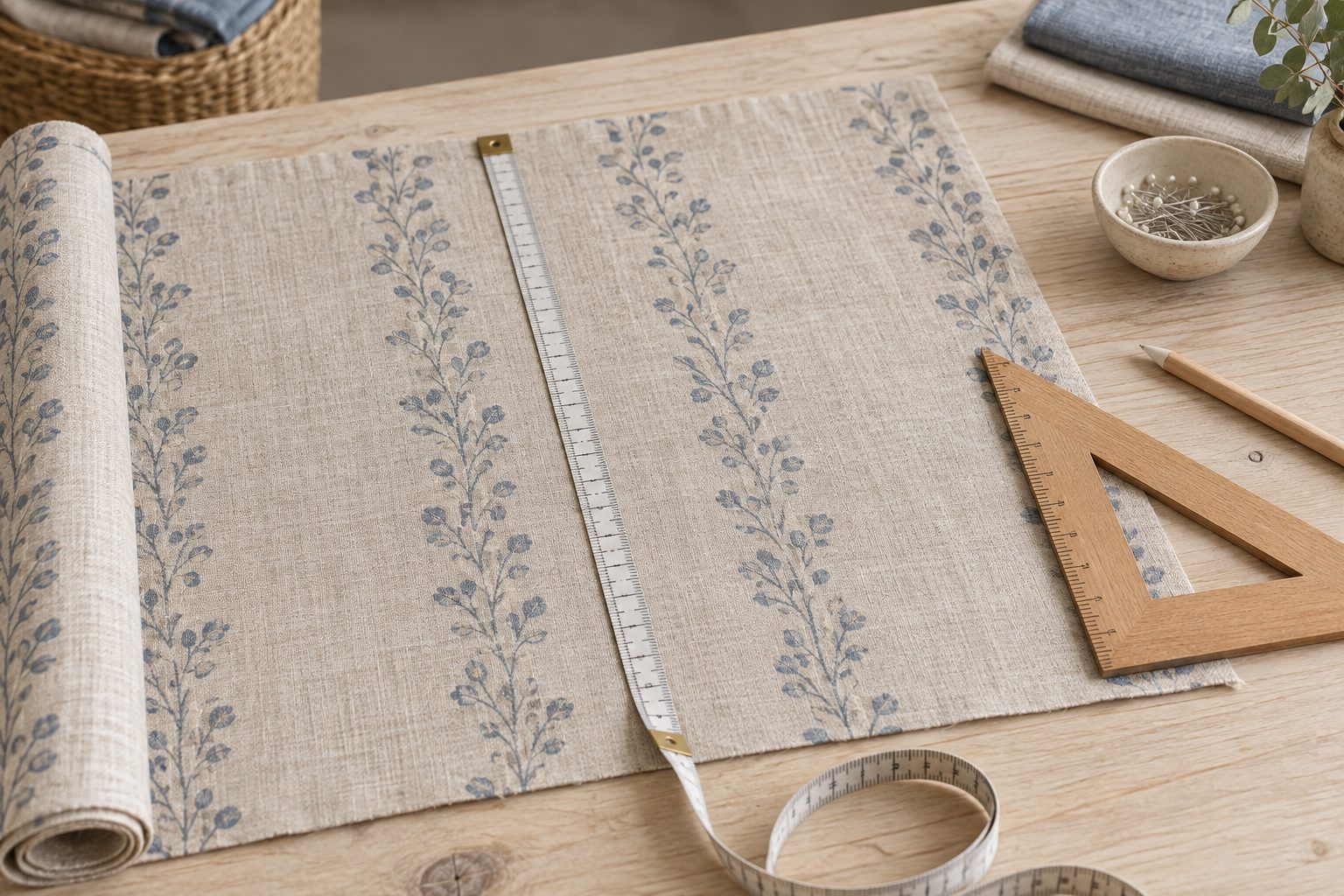
Roman blind fabric examples
| Finished blind | Assumptions | Planning quantity |
|---|---|---|
| 90 × 120 cm | 140 cm usable width; 10 cm total side allowance; 25 cm top and hem allowance; plain fabric | 1 width × 145 cm = about 1.5 m |
| 120 × 160 cm | 140 cm usable width; 10 cm total side allowance; 25 cm top and hem allowance; plain fabric | 1 width × 185 cm = about 1.9 m |
| 160 × 180 cm | 140 cm usable width; 10 cm total side allowance; 25 cm top and hem allowance; plain fabric | 2 widths × 205 cm = about 4.1 m |
| 160 × 180 cm | Same blind with a 32 cm vertical repeat | 2 widths × 224 cm = about 4.5 m, before motif-placement allowance |
Important: these are planning examples, not cutting instructions. Round the final result up to the retailer’s selling increment and confirm the cutting plan before ordering.
Do I need the same amount of lining?
Calculate lining separately. Its width may differ from the face fabric, and the lining construction can include additional material for rod pockets or tapes. Blackout lining, interlining and standard lining can also behave differently in the folds.
Use the lining specification and the instructions for the exact blind-making system. Do not simply copy the face-fabric quantity unless the pattern explicitly tells you to do so.
Which linen works for Roman blinds?
A Roman blind needs enough body to form orderly folds without becoming unnecessarily bulky. Fabric weight, weave stability, opacity and how the material behaves with lining all matter. Our guide to choosing linen fabric explains how to compare weight, weave and finish.
Before ordering the full length, request linen fabric samples. Hold them against the window in daylight and after dark. Check colour, texture, show-through and whether the chosen lining changes the appearance. If the finished blind may be cleaned or washed, follow the supplier’s care guidance and account for any documented shrinkage before cutting.
Common Roman blind measuring mistakes
- measuring only the glass instead of the required finished blind;
- using the widest recess measurement instead of checking for an uneven opening;
- forgetting side, top and bottom construction allowances;
- using the full fabric width when the selvedges must be removed;
- adding curtain fullness even though a flat Roman blind does not need it;
- ignoring the vertical repeat or motif placement;
- placing joins asymmetrically on a wide blind;
- assuming the lining uses the same cutting plan as the face fabric; and
- ordering the exact mathematical quantity with no allowance for squaring or cutting.
Roman blind measurement checklist
- Choose an inside- or outside-recess fitting.
- Record the finished width and drop in one unit.
- Check the fabric’s usable width and pattern repeat.
- Add the allowances required by the exact blind-making method.
- Round up the number of widths.
- Round each patterned cut drop up to a complete repeat.
- Plan symmetrical joins if more than one width is needed.
- Calculate lining and interlining separately.
- Round up to the selling increment and verify the final cutting plan.
If you are planning other window treatments, see our guide to measuring curtains and calculating fabric yardage. For conversions, read how big a yard of fabric is.
Frequently asked questions
How much fabric do I need for a standard Roman blind?
If the finished cut width fits inside one usable fabric width, a plain Roman blind often needs one length equal to the finished drop plus the required top and bottom allowances. With a combined allowance of 20–25 cm, a 160 cm drop commonly starts at about 180–185 cm of fabric before purchase rounding.
Do Roman blinds need extra fabric for fullness?
No. A standard flat Roman blind does not use gathered fullness like a curtain. Add construction allowances and pattern-matching requirements, but do not multiply the width by a curtain fullness ratio.
What if the blind is wider than the fabric?
Use additional cut widths. A visually balanced layout normally places a full-width panel in the centre and equal narrower panels at the sides. Multiply the cut drop by the number of widths and include any pattern-matching allowance.
How much extra fabric should I allow for a pattern repeat?
Round every cut drop up to a complete vertical repeat. For precise motif placement, you may also need one additional repeat. Half-drop and directional patterns can require more, so check the repeat type before ordering.
Should I ask a professional to verify the quantity?
Yes, especially for large blinds, expensive patterned fabric, blackout or interlined construction, or unfamiliar headrail systems. A supplier or blind maker can verify the final quantity against the actual construction method.
Ready to compare colours and weights? Browse linen fabrics for home décor and order samples before committing to the full length.